
Most SaaS founders treat naming as the creative part, and the domain as an afterthought. That order works against them. A good SaaS product name is memorable, easy to spell, available as a matching domain, and flexible enough to grow with the product instead of describing only its first feature. Founders who consider all four factors before locking in a name aren't forced to rebrand a year later.
TL;DR
A strong SaaS product name in 2026 is memorable, pronounceable, and built to scale past your first feature set, not just describe today's product.
Naming styles fall into a few reliable patterns: descriptive, evocative, compound, and invented.
Check your domain while you're choosing the name, not after you've already committed to it.
Your SaaS product name and domain name should ideally match. Domain extensions like .tech can make that possible even when the exact .com isn't available.
Before locking in a name, check domain and trademark availability, social handles, and how it sounds out loud.
Step 1: Work out what makes a SaaS product name actually work
A SaaS product name works when it's easy to say, spell, and remember, when the matching domain is available, and when it can grow with the product instead of being tied to where it started.
1. It's memorable and easy to say out loud
A name that's easy to say and repeat travels faster through referrals, demos, and casual recommendations. Short names tend to stick after being heard just once.
2. Its exact-match domain is available
Founders who check domain availability only after falling in love with a name tend to waste weeks. Building the domain check into the naming process from the start, rather than treating it as a final step, avoids that trap entirely.
An unavailable .com doesn't necessarily mean the name itself is unavailable. Domain extensions like .tech can give founders another route to a clean exact-match domain without changing the name.
3. It leaves room to grow
A name tied too tightly to one feature or technology can be restrictive. A product that starts as a scheduling tool and expands into full workflow automation needs a name that survives that expansion, not one that describes only the first version.
4. It skips the trend of the moment
Every SaaS naming cycle has its cliché. Suffixes like “-ly” and “-ify” defined one era, while “AI-” prefixes have defined another.
Names anchored to a current trend tend to feel dated within a few years, so it's worth choosing something that would still make sense without the trend attached.
Step 2: Choose the naming style that fits
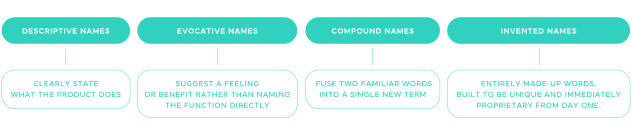
Successful SaaS product names generally fall into one of four patterns:
1. Descriptive names
Descriptive names clearly state what the product does, so a customer understands the pitch before you've said a word.
The domain extension can carry part of that description too. Read together with the name, an extension like .tech can tell a customer the product is tech-first without the name alone having to do all that work.
2. Evocative names
Evocative names suggest a feeling or benefit rather than naming the function directly, such as names that imply speed, calm, or reliability.
3. Compound names
Compound names fuse two familiar words into a single new term, pairing something recognizable with something unexpected.
4. Invented names
Invented names are entirely made-up words, built to be unique and immediately proprietary from day one.
Whichever style you choose, the name still has to work once someone tries to find it online. As your shortlist takes shape, running the strongest options through Spaceship's domain search can show you which names, and which extensions, are actually available.
Step 3: Check the name and domain together
If the exact-match domain for your SaaS product name isn't available on .com, the instinct is often to modify the domain to force a match.
That might mean get[name].com, try[name].com, or [name]app.com.
Those can work, but every extra word creates another version of the brand someone has to remember.
An exact match between your SaaS product name and domain name removes that friction. It's easier to remember and type without guessing, and easier to spread by word of mouth.
Instead of treating .com availability as the final verdict on a name, consider whether another extension fits the company you're building.
A domain extension like .tech, for example, lets you register yourbrand.tech and keep the name exactly as you chose it, with nothing added or altered.
If you've got several names or extensions in contention, run the shortlist through Spaceship's domain search before getting too attached to one.
Step 4: Choose a domain extension that fits where the company is going
.tech, .io, and .ai can all make sense for SaaS companies, but they communicate slightly different things.
.tech is also an established namespace: 559,569 .tech domains were reported for May 2026, based on ICANN monthly registry reports. Source: ICANN's .tech Monthly Registry Reports, with the May 2026 total aggregated by nTLDData.
The point isn't that the alternatives are poor choices.
If AI is fundamental to the company and likely to remain that way, .ai makes that positioning obvious. If you're building primarily for developers, .io has years of recognition in that world.
.tech becomes particularly useful when you want a clear technology identity without tying the brand to one technology, audience, or product category.
Can a .tech domain support a credible SaaS brand?
A domain extension doesn't create customer or investor trust by itself. The product, team, customers, security, and reputation do much more of that work.
But relevance can help a brand make sense quickly. A technology company using a .tech domain creates an immediate connection between the brand and the category it operates in.
And established companies already use the extension.
Hex | hex.tech
hex.tech is used by Hex, a data and AI analytics platform that helps teams run analysis, build models, and share insights in one workspace. Its published customer stories include companies such as Notion and Reddit.
Zeta | zeta.tech
zeta.tech is used by Zeta, a next-generation card processor whose cloud-native platform helps financial institutions launch and operate card programs.
Turso | turso.tech
turso.tech is used by Turso, a database platform built for modern applications and developer workloads.
Those examples don't prove that .tech creates trust on its own. They show that the extension can sit naturally behind credible technology brands without the domain getting in the way.
Step 5: Validate the name before locking it in

A SaaS product name isn't ready to lock in until it clears these checks:
1. Domain and trademark availability
Check whether the matching domain name is available, and run a basic trademark check on the name. A name that has an available domain but is already trademarked in your category can force an expensive rebrand later, so it's worth catching that conflict before any decisions are made.
You can use Spaceship's domain search to compare available names and extensions as you narrow the shortlist.
2. Social handle consistency
Check if the name has a matching social handle on the platforms your customers actually use. Consistent social handles make a new brand easier to find, and a single squatted handle on a key platform is worth knowing about before you pick a name rather than after.
3. The radio test
Check if the name sticks. Say the name to a handful of people who've never seen it written down, then ask them to spell it back.
If they consistently get it wrong, that's a signal worth taking seriously before the name is locked.
4. The five-year test
Ask whether the name would still make sense if the company expanded into new products, features, or categories.
A good name should survive more than the version of the product you have today.
Ready to check the shortlist? See which domains are available at Spaceship. Eligible domain registrations and transfers include free domain privacy.
Step 6: Avoid the naming mistakes that age badly
The costliest naming mistakes for SaaS founders stem from chasing a trend rather than building something durable.
1. Leaning too heavily on AI prefixes
Attaching AI to a name made sense when the technology was novel. As it becomes standard across more software categories, an “AI-” prefix may stop differentiating the product as clearly as it once did.
If AI is fundamental to the long-term brand, it can still make sense. If it's simply part of how the first product works, think carefully before making it permanent.
2. Defaulting to generic suffixes
Suffixes like “-ly” and “-ify” once felt fresh, but an entire category of tools now sounds alike because of them. A name built on a worn suffix can blend into the crowd it was meant to stand out from.
3. Prioritizing cleverness over clarity
A name that requires an explanation before anyone understands it works against the founder, not for them. Being clear beats being clever in almost every sales conversation.
4. Naming around version one
A name tied to a single feature may describe a first release well but becomes a liability the moment the product expands.
The best names describe a category or a feeling, not a specific function that might not exist in three years.
So, how do you turn a SaaS product name into a brand that lasts?
The strongest SaaS brands choose their name, their domain, and their social handle together, not one after another.
Treating them as a single decision from day one is what makes a name last.
Memorable and flexible – Pick a name that grows with the product, not just its first version.
A domain extension that fits – Choose one that reinforces the identity you're building without unnecessarily locking you into a category.
A matching social handle – Secure it before you lock in the name.
A consistent customer-facing identity – Think about the domain and the professional email address customers will see alongside the brand.
A five-year test – Judge the name by whether it'll still make sense later, not by how current it feels today.
For a SaaS company that wants an exact-match domain, a clear technology identity, and enough flexibility to move across products or categories, .tech makes a strong case.
Once you've found the name that passes all of those tests, the final step is simple: check the domain and secure it while it's available.

Share your thoughts