¿Qué tecnología de virtualización está configurada en nuestro VPS?
Los servidores privados virtuales (VPS) son una opción perfecta entre el hosting compartido y los servidores dedicados, ya que este tipo de hosting permite un nivel bien equilibrado de control, rendimiento y seguridad. La tecnología de virtualización es lo que hace que todo esto sea posible.
El hosting VPS de Spaceship utiliza KVM (Kernel-based Virtual Machine), una popular tecnología de virtualización de código abierto conocida por su sólido rendimiento y flexibilidad.
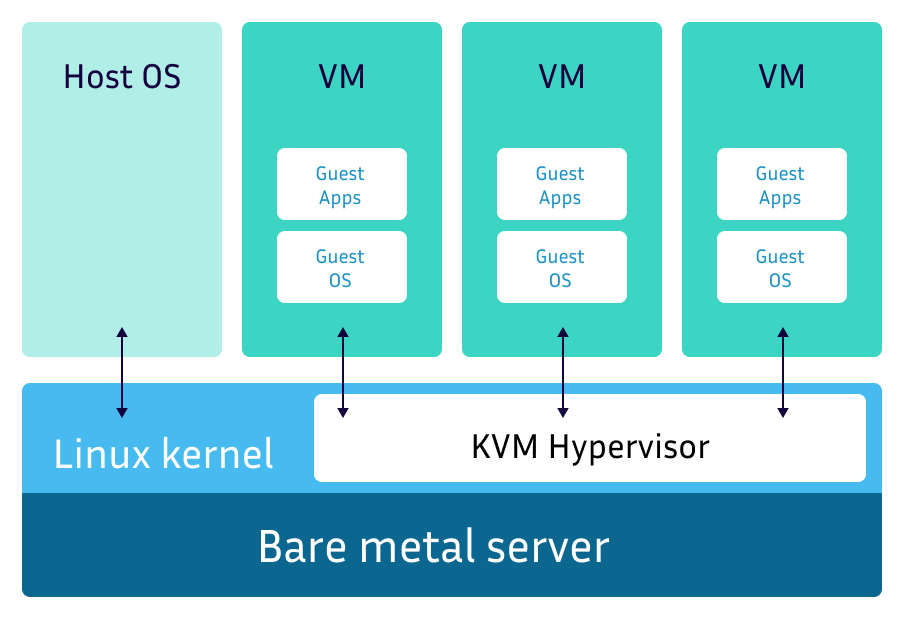
KVM es una solución de virtualización de código abierto integrada directamente en el kernel de Linux, convirtiéndolo en un hipervisor bare metal. Un hipervisor es un tipo de software que puede gestionar de forma eficiente múltiples máquinas virtuales aisladas en un solo servidor.
KVM requiere extensiones de virtualización de hardware como Intel VT-x o AMD-V para funcionar. Estas extensiones permiten a KVM aprovechar la mayoría de las capacidades del hardware, garantizando un rendimiento casi equivalente al del hardware físico y un uso eficiente de los recursos.
Aquí puedes ver la arquitectura de KVM:
Características de KVM
Compatibilidad de hardware
Existe una amplia selección de plataformas de hardware certificadas compatibles con Linux que admiten KVM. Los proveedores de hardware también contribuyen con frecuencia al desarrollo del kernel, por lo que las nuevas funciones de hardware suelen integrarse rápidamente en el kernel de Linux.
Virtualización completa
Con la virtualización completa, cada VM obtiene los servicios típicos de un sistema físico, como BIOS virtual y hardware. Esto permite a los usuarios ejecutar sistemas operativos invitados sin modificar, como si se estuvieran ejecutando en hardware físico dedicado.
Emulación de hardware
KVM emula los componentes de hardware para las VM, como la CPU, la RAM, los adaptadores de red y los dispositivos de almacenamiento.
Gestión de memoria
KVM hereda las funciones de gestión de memoria de Linux, como el acceso no uniforme a memoria y la fusión de páginas idénticas del kernel. La memoria de una máquina virtual puede intercambiarse, contar con compatibilidad con grandes volúmenes para mejorar el rendimiento, y compartirse o respaldarse mediante un archivo de disco.
Almacenamiento
Cualquier almacenamiento compatible con Linux puede utilizarse para KVM, como, por ejemplo, discos locales y almacenamiento conectado a la red (NAS). Los sistemas de archivos compartidos también son compatibles y pueden ser utilizados por varios hosts.
Migración en vivo
La migración en vivo en KVM permite mover una VM en ejecución entre nodos sin interrupción del servicio. La VM permanece en línea con aplicaciones activas y conexiones de red.
Menor latencia y mayor priorización
El kernel de Linux contiene extensiones en tiempo real que permiten que las aplicaciones basadas en VM se ejecuten con menor latencia y mejor priorización en comparación con los sistemas bare metal. También divide los procesos con tiempos de ejecución largos en tareas más pequeñas, que luego se programan y procesan de forma eficiente.
Ventajas de KVM
KVM ofrece varias ventajas como solución de virtualización, especialmente para empresas y desarrolladores que utilizan entornos basados en Linux. Características como la integración en el kernel de Linux y su naturaleza de código abierto hacen de KVM una excelente opción para una virtualización eficiente y segura. Las principales ventajas de KVM son:
Compatibilidad: con KVM tienes una amplia selección de sistemas operativos para instalar en una VM. También puedes ajustar la configuración del kernel de bajo nivel para adaptarla a tus necesidades, ya que KVM solo se ejecuta en hardware compatible con virtualización asistida por hardware.
Rendimiento: KVM es un hipervisor de tipo 1, lo que significa que se instala directamente en un servidor físico sin que haya ningún software ejecutándose entre el hardware y el hipervisor. Esto permite lograr un alto rendimiento casi equivalente al del hardware físico en comparación con los hipervisores de tipo 2.
Escalabilidad: Como módulo del kernel de Linux, KVM se ajusta automáticamente para gestionar mayores cargas de trabajo a medida que aumenta el número de máquinas virtuales. Gracias a su rendimiento basado en Linux, KVM escala de forma eficiente para satisfacer las demandas de las aplicaciones que consumen muchos recursos.
Seguridad: KVM aprovecha la mayoría de las funciones de seguridad de Linux, como la aplicación estable de parches de seguridad y los procesos de desarrollo continuo. También existe un menor riesgo de ataques entre VM, logrado al aislar cada VM mediante una combinación de Linux con seguridad mejorada (SELinux) y virtualización segura (sVirt).
Madurez: KVM se creó en 2006 y desde entonces se ha desarrollado y mejorado continuamente, lo que lo convierte en una solución de virtualización madura y fiable. También recibe soporte regular de una comunidad de código abierto.
Conclusión
KVM (Kernel-based Virtual Machine) es una solución de virtualización potente y versátil que transforma el kernel de Linux en un hipervisor. Su profunda integración con el kernel de Linux, su compatibilidad con la aceleración por hardware y su sólido rendimiento lo convierten en una opción ideal para diversas aplicaciones, desde la consolidación de servidores hasta la computación en la nube.