
The right domain is key to starting your digital life. And if the Internet is evolving every day, then so is the need for domains.
Domains aren’t just addresses. They’re assets. They evolve brands into icons and can soar to be worth millions. So you need to choose carefully.
Let’s learn the key mistakes of domain name searching, so you can start your online journey right.
Not considering your brand
Your domain isn’t just a string of text. It’s part of your digital identity. Credibility, character, purpose — domains say a lot about you. If they’re part of what your brand stands for, then you need to truly know your brand.
Ask yourself:
What drives your value?
What makes up your personality?
What does your audience really want?
If you don’t know these, you won’t find the right domain, and you’ll be limiting your chances of growing your online presence. That’s why it’s so important to consider your brand carefully before choosing a domain name.
Getting domain extensions wrong
Top-level domains (TLDs), or extensions, are everything to the right of the dot — .com, .net, .org, etc. Their technical function isn’t important right now, but what they mean to your audience is.
In short, a TLD enhances your domain. It adds connotations to your brand and helps establish its identity. Just look at the world’s most popular domain — .com. It’s natural to ask whether the .com domain is still worth it. But what can’t be denied is that it adds reputation, trust, and international standing.
Simply put, each TLD says something different. But it’s a double-edged sword, and the wrong TLD can be damaging — booksforchildren.adult tells this story well.
Lesser-known TLDs, like .vin, .casa, and .esq, shouldn’t be forgotten. They have advantages, like brand uniqueness and modern values. But the less your audience recognises your address, the less likely they are to remember it.
Don’t make the mistake of missing the balance — finding the right extension means giving it proper thought.
Too long, too complicated

Online brands can make things complex. In every case, you want the path of least resistance to your site, and your domain is part of that structure. Don’t make it too long, don’t make it too messy, and don’t make it too weird.
A few easy principles apply here:
Simple = memorable, accessible, and easy to spell.
Short = memorable, accessible, and easy to spell.
Joining the dots?
Okay, sure, maybe your brand name is a little long. Your domain could still mirror that. You want to tie in your brand and be recognised, after all. But failing to make it as simple as possible could seriously impact your growth.
Failing to consider future growth
Your online future isn’t a one-stop destination. It’s an ever-changing, ever-growing evolution of value. Your brand, products, or services may change over time. And you should be thinking about that now.
People choose domains that end up being completely out of step with their image further down the line. Usually, it’s because they’re too specific.
Let’s say you have a tyre shop, so you register trustytires.com. But as part of that 20-year projection, you want to branch out. Maybe you want to sell different parts or be known for sustainability too.
When you reach that point, you have to ask: Is trustytires.com covering the ground it needs to?
Or would autosolutions.com be a better choice?
It’s simple, don’t restrict yourself. And given the right domain is more important than ever, you need to choose one that grows with you.
Not checking social media availability
From plastering logos on webpages to content-style ads in Instagram feeds — online brands are synonymous with social media presence.
Failing to realise this is costly.
Spreading your digital estate across online channels is an obvious way to grow. And if your domain name isn’t available on Instagram, TikTok, or YouTube, that’s fewer users making it through to checkout.
The mistake? People just don’t look. Or at least, they don’t know where to look. Sites like Namechk and BrandSnag make it very easy. So, don’t miss out on these social opportunities.
Dismissing SEO

Search engine optimisation (SEO) shouldn’t be a footnote in your domain plans. You can use SEO as a powerful strategic approach when finding a domain name. If overlooked, it could see you tumbling down the results pages.
Let’s learn it, and keep it simple.
Using keywords wrongly
Keywords are search terms that help with ranking online. They’re words that relate to you and your offerings.
If you sell quality scarves, having the words ‘quality’ and ‘scarves’ in your domain makes sense. People wanting quality scarves will search for… quality scarves.
Keywords can clearly be important.
While the true impact of domain keywords isn’t known, some things are certain. And they sit comfortably under these concepts:
Searchability
Relevance
Trust
Let’s use buycoffeenow.com to break it down.
Firstly, SEO applies to your entire site. So if you have coffee in your domain but never again on your pages, your relevance won’t be as high. And you’ll be left hanging by Google.
Another error here is cramming (this is where trust comes into play). Using the now modified buycoffeenowcheap.com, Google detects that you’re squeezing keywords in. So even if it’s relevant, it’s not trustworthy. And your ranking takes a hit.
It’s not just Google that needs to trust you. If you choose a domain that looks suspicious, users won’t click through, which affects your click-through rate (CTR). If you look cheap, other sites won’t link to you either. All of this affects your SEO ranking.
The remedy is quick — use tools like Semrush or Google’s Keyword Planner to find the best keywords for you.
Mismatching branding and SEO
Let’s take buycoffeenow.com again. You know it lacks trust, and you can feel the keyword cramming, but there’s another dimension to its shortfall — identity.
A strong brand feels unique and original. Good domain names should reflect that. Picking auto-generated, generic-sounding keywords is unlikely to impress.
On the other end of the scale? Being too unique. Don’t use made-up words for a ‘quirky’ brand — one that no one will remember.
Failing to check domain history

A company’s reputation is the backbone of its public relations. Ever heard of businesses failing due to scandals and malpractice? International corporations, medium-sized start-ups, and even personal brands — reputation is key.
But while start-ups are starting fresh, the domains they use might not be.
Domains can be resold and re-registered. Like real estate, they change hands, building up a history of previous owners, who affect the property in different ways. Some of those ways are damaging.
Bad backlinks, shady SEO practices, previous scandals — domains can have horrible histories, and failing to check could cost you your brand.
Sure, when you search domain names for a basic domain name lookup, there are waves of tools to help online. But any decent domain registrar should give as much domain history as it can upfront, completely free. You just need to run a quick domain name search and check each domain’s info right there in the results.
If you find yourself with a registrar that doesn’t show this for you, then you may have to use tools like these:
Wayback Machine – an online archive with screenshots of sites over time.
WHOIS lookup – detailed information on domain ownership and registration.
DomainTools – data and insights on domain history and security.
Not considering the law
Scandals of the past are one thing, but being the scandal is another.
When you search for a domain, you have to think legally. Trademark issues are rife in online history. Cybersquatting, registering domains similar to trademarked brands, is a risk too.
In 2012, Pinterest won a trademark dispute against a travel start-up. That start-up registered pintrips.com. The business argued it wasn’t infringing, but Pinterest won anyway. Clearly, the line of infringement is sensitive.
Search your competition — you don’t want to end up in court as well.
Not using tools to search domains
So your digital life is close to launching. You can spot bad domains from webpages away, you’ve sized up a TLD already, and you’re an expert in online infringement.
Next?
Actually searching for a domain can be tricky. Beyond checking domain availability, there’s a lot to think about.
One of the biggest mistakes is being shut away in a room with just a pen, paper, and an ever-fading imagination.
Why is this a mistake? Search tools aren’t being used:
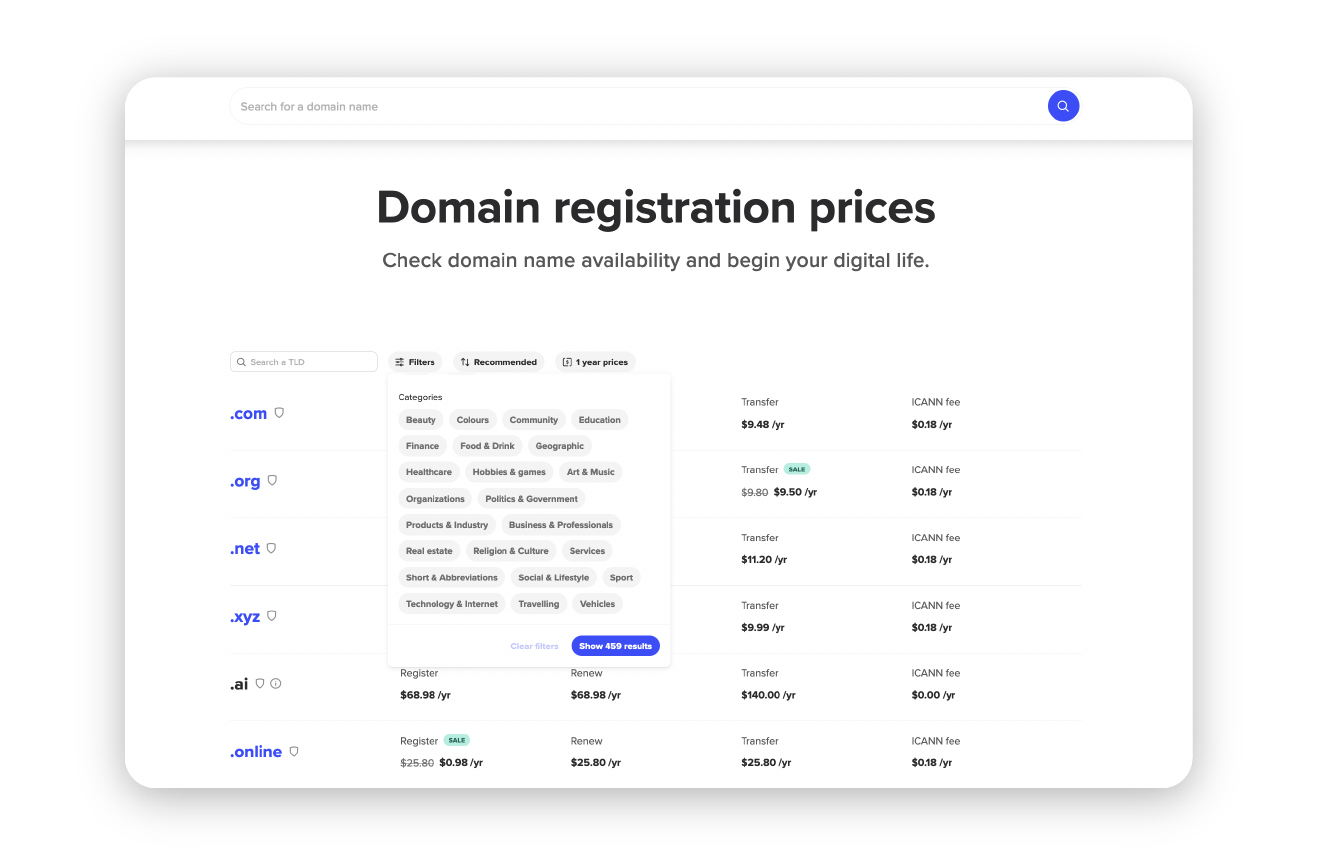
Filtering domains by different qualities can quickly narrow things down. You’ve got industry, popularity, TLD types, and more.
TLD pages can help you understand the strengths of extensions in minutes.
Having quick suggestions for domain alternatives helps you explore your ideas quickly, with half the work done for you.
Rushing in to register
The last mistake is obvious — take your time. It’s one of the best practices for domain name searching. This is your online future, and the right domain could be key to its success.
Research, plan, iterate, then research some more. Do all you can to land the perfect address and definitely don’t skip what’s important. Then just choose the right domain provider, platform, and price. Simple.
Start searching today, and discover the best domain for you.
Frequently asked questions
Spaceship makes availability simple and clear. When you search for a domain, the results will show whether the domain in question is available or taken.
Registering a domain is simple. Just search for your domain to check if it’s available. If it is, hit Add to cart, and follow the checkout process from there.
Some domains are restricted in use, by region, organisation type, and trademark regulations. To check, head to the registry managing the domain, and you should find the information there.
Searching for a domain name is easy. Head to Spaceship, search for a domain, and see if it’s available. You can also use filters and categories to refine your search.
Checking domain quality takes a lot of consideration. What’s right for you and your brand is important. Learn more with Spaceship to understand what makes a quality domain.

Suggested articles




Share your thoughts